
Cudahy Resident Lookup: Records That Confirm Identity
Los Angeles County holds most of the records used in a Cudahy resident lookup. The city supplies municipal files, while the Assessor, Registrar-Recorder/County Clerk, Elections office, Superior Court, and state custodians answer different parts of the question. A property result can confirm a parcel and titled interest. It cannot, by itself, prove who sleeps there. A court index can show a party name and case event. It is not a complete life history. Start with the record that matches the clue already in hand.
| Record | What It Confirms | Where | Access |
|---|---|---|---|
| Assessor roll and PDB | Titled interest, situs, AIN, and parcel facts | LA County Assessor | Free address/AIN search; owner name by PDB, counter, or phone |
| Recorded deeds | Named parties and a property chain | LA County RR/CC | Records since 1850; request or counter, with no public online index |
| Voter status or file | A voter’s own status, or authorized-purpose registration data | California SOS and LA RR/CC | Authenticated self-check or restricted file access under Elections Code §2194 |
| Court and probate records | Party variants, case events, and possible heirs | LA Superior Court | Paid name search, courthouse terminal, or clerk copy |
| Vital records | Birth, death, marriage, divorce, and family links | LA RR/CC and CDPH | Eligibility and copy type control access |
| Business, FBN, and license files | Organizational affiliation, trade name, or license status | SOS, county, and DCA | Public searches; an address role is not residence proof |
When only a name is known, test spelling, middle initials, co-owner or spouse names, and a likely date range before treating a result as a match. When an address is known, the Assessor is the better first door because it can return an AIN. The AIN then gives the deed and parcel trail a stable key. If the goal is one person rather than a parcel, court, vital, or probate records may carry more weight than an owner result.
Cudahy Resident Records Start With an AIN
The Los Angeles County Assessor property search is free and built around an AIN or full situs address. An AIN is the mapbook-page-parcel number assigned to a parcel. The address autocomplete can supply the city, ZIP, and AIN, making it useful when a street address is the first clue. It does not provide a free owner-name browse. A situs address is the physical place. It is not the same as an assessee mailing address, and neither one proves occupancy.
| AIN | One of two main search paths; normally a 10-digit mapbook-page-parcel value. |
|---|---|
| Address | One of two main search paths; enter the full situs address and use the autocomplete. |
| Assessee name | Available through the Property Database, not the free public parcel search. |
| Situs address | A Property Database search mode for one parcel record at a time. |
For a name-first resident lookup, the Assessor Property Database access page describes paid remote access at $100 per month plus $1 per inquiry, a $168 token, and a $200 trust account. Free regional-office terminals and telephone service at 213-974-3363 are alternatives. The ordinary parcel result can show use, parcel type, tax-rate area, exemption, units, beds and baths, map information, values, land area, zoning, legal description, and building-year details. Treat those fields as parcel evidence, not as a household roster.
Note: A trust, LLC, agent, or mailing address can sit between a Cudahy parcel and the person you are trying to identify.
Cudahy Court Lookup: Names, Dates, and Limits
There is no municipal court for Cudahy. The Los Angeles Superior Court serves the city, and the Bellflower Courthouse is in the Southeast Judicial District at 10025 E. Flower Street. The general phone is 562-345-3300. The courthouse is open from 8:00 a.m. to 4:30 p.m.; the clerk window runs from 8:30 a.m. to 4:30 p.m. A resident lookup through court records should use the case division and date range that fit the question. California has no single statewide trial-court party-name search.
The LA Superior Court guest information page explains the paid search path for civil, family, probate, small-claims, and criminal defendant records. Unlimited civil, probate, and family searches reach 1983 to the present. Limited civil searches reach 1991 to the present, and small-claims searches reach 1992 to the present. Civil, family, probate, and small-claims searches charge a nonrefundable fee even when no match appears. A criminal defendant search uses last and first name, with Exact Match or Starts With choices.
Purchased name results stay available for two hours. Documents remain available for 30 days. Images often appear within 72 hours. Image charges are $1 per page for pages 1 through 5, then $0.40 per page, with a $40 maximum per document. Sealed and confidential matters, adoption, juvenile, paternity, minor-related, and some family material are not exposed through the public remote view. A courthouse terminal can show more public electronic material than remote access.
These limits make the court index a focused corroboration tool. A matching name and case number can support identity research, but the result still needs an address, date, relationship, or other independent anchor.
Note: A paid no-match result is still a search transaction, so narrow the division, name form, and date range before submitting it.
The civil and family party-name interface shows how the search begins with a person or company name and a search transaction. Its layout is a useful reminder that party searches are not the same as document retrieval.
The LA Superior Court guest information page is the source for the payment and access screen shown below.
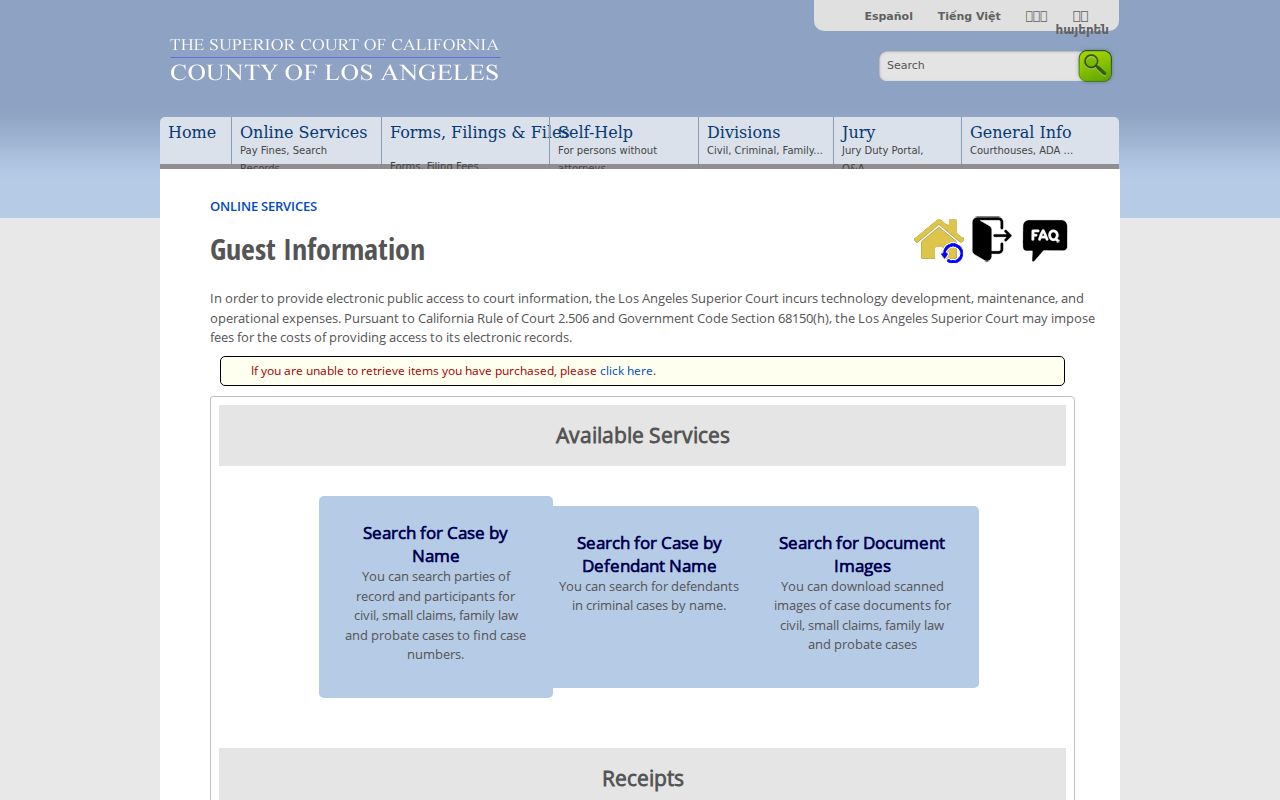
The court’s guest information view places payment, access mode, and public-record limits beside the name-search path. That context helps keep a Cudahy resident lookup tied to the right court division.
Cudahy Lookup Results and Dockets
A docket is the court’s running list of case events, filings, and hearings. It is an index and case summary, not automatically the complete official file. The LA Superior Court access and fee information distinguishes a purchased search result from an image order and notes that public data can contain errors or omissions.
| Party or defendant name | The spelling and name form returned by the search. |
|---|---|
| Case number | The identifier used to open a case summary or request a clerk copy. |
| Case type and category | For example, civil, family, probate, small claims, or criminal. |
| Filing date and location | The date and courthouse connected to the public case entry. |
| Image count and availability | Whether public documents are available and how many image pages are listed. |
| Events and hearings | Register entries or case-summary activity when the public view permits it. |
Read the name, case number, filing date, and courthouse together. A common name with no matching date or place is not enough. If a document matters, order the permitted image or ask the clerk for a copy. State clerk copies generally cost $0.50 per page, certification is $40 per document, and a search taking more than 10 minutes is $15. A certified copy is a clerk-authenticated reproduction that can carry official evidentiary weight. A screen result or ordinary image is not the same thing.
The party-name search screen makes the transaction boundary visible. It is useful for a first check, while the case file and clerk are the right sources for a record that must be quoted or filed elsewhere.
The LA Superior Court civil index is the source for the party-name screen shown here.
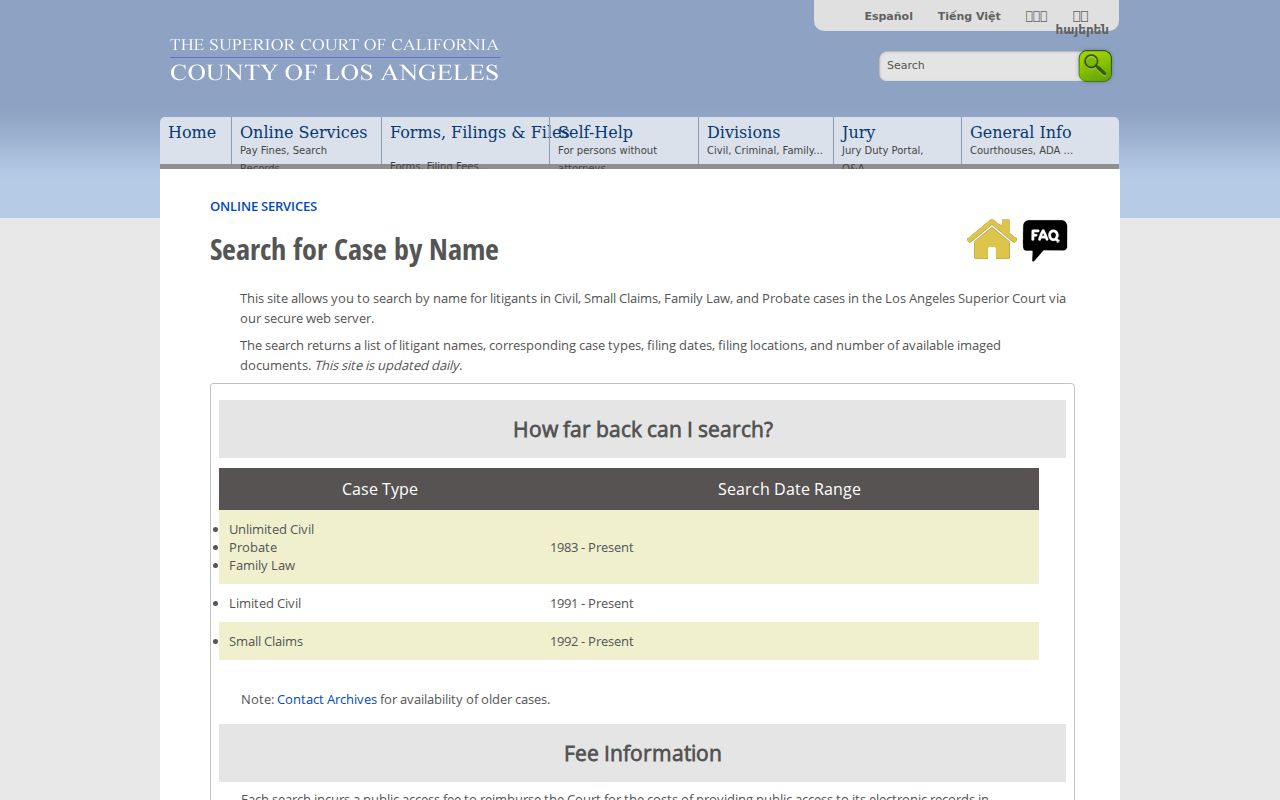
The civil index image shows the name-first route used for several LA Superior Court divisions. It also reinforces why variant spellings and the correct case category matter.
The court’s fee and scope page adds a second layer of caution for online images. Family-law access can be narrower than a general civil case, and sealed, confidential, adoption, juvenile, paternity, and minor records are not ordinary search results.
The LA Superior Court FAQ is the source for the fee and image-access details shown next.
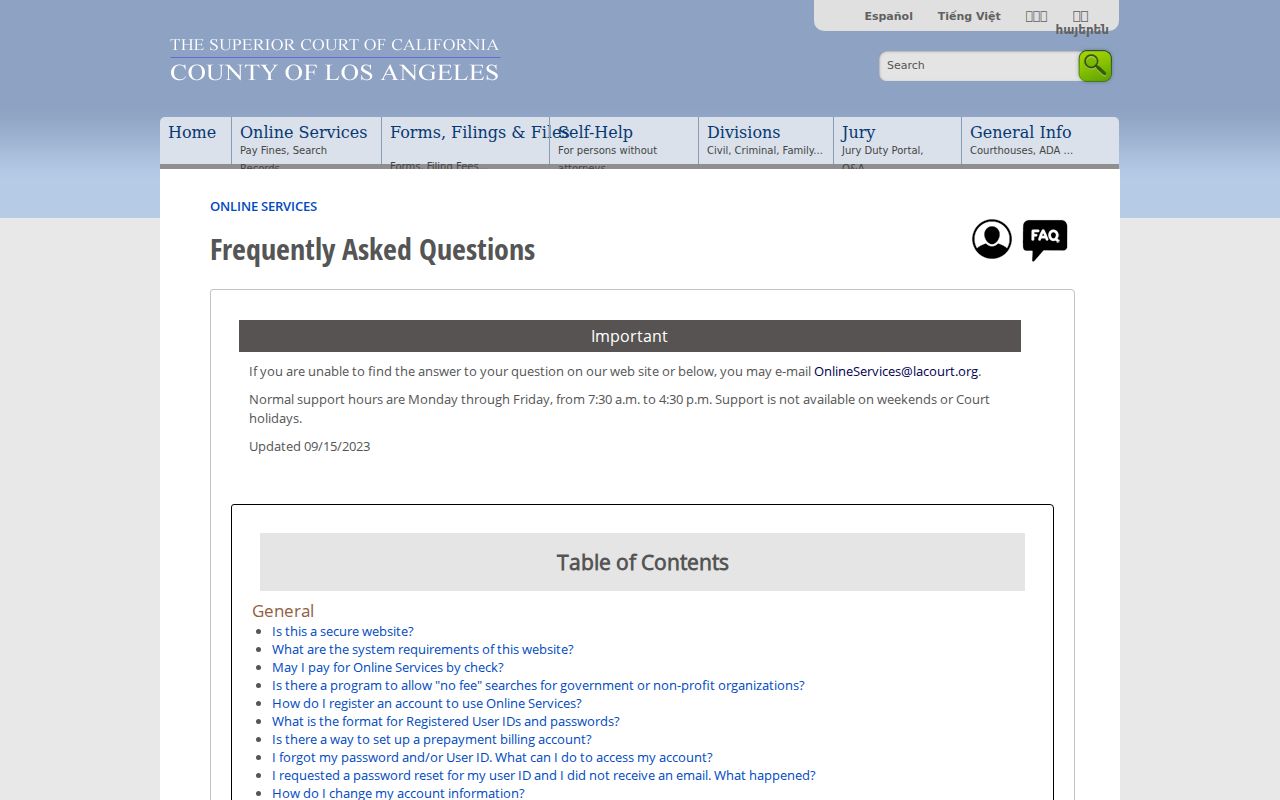
Fee and access notes should be read before a paid transaction. They explain why an absent image is not proof that a case or family record never existed.
Cudahy Federal Records Need a Different Door
A state-court name search does not cover federal cases. For a federal party or docket, use PACER and the Central District of California records instructions. PACER charges $0.10 per page, and a quarterly bill of $30 or less is waived. Archived files may take 5 to 10 days to arrive from the Federal Records Center. That delay is part of the access path, not a sign that a search failed.
The Central District of California records page is the source for federal access choices. Federal results can add a separate case number, party role, filing date, and image trail to a Cudahy resident lookup. They still require the same identity checks as a county result. A federal party name, like a state party name, can belong to a person with no connection to the address being researched.
PACER is best used after a name, spelling variant, or case clue has been narrowed. Keep the court system, district, and date in the result inventory. Do not blend a federal docket with a Superior Court case simply because both use similar names.
The federal record route is separate from the local county chain, but the discipline is the same: preserve the identifier, read the party role, and seek the underlying document when a summary is not enough.
The Central District of California records page is the source for the federal access view below.
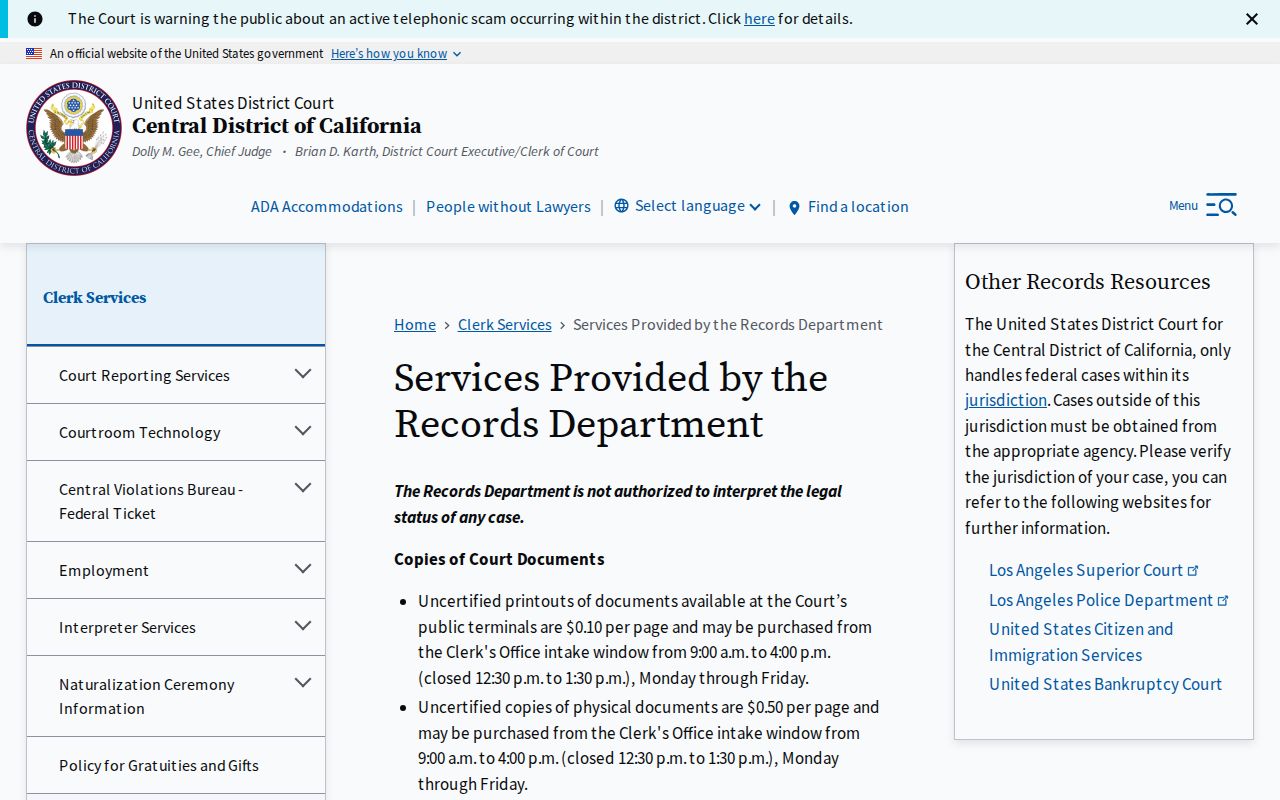
The federal records view marks the boundary between a local Los Angeles court search and a Central District federal search. Keeping those systems separate prevents a false match.
Verify a Cudahy Resident Across Records
A reliable resident lookup is a sequence, not a single name hit. The strongest path anchors a person to a dated address or AIN, then checks an independent record that carries a different kind of fact. A deed can identify named parties to a property transfer. A court entry can identify a party and event. A vital record can link an event to a family relationship. None should be stretched beyond what its custodian records.
- Write the full name, middle initial, known spelling variants, likely date range, and any dated Cudahy address or AIN.
- Use the Assessor address search to confirm the parcel, then move to the owner-name PDB, counter, or phone channel only when a name-first check is needed.
- Run the LA Superior Court search in the correct division with the exact name, a split or joined surname form, and a sensible date range.
- Compare the case number, filing location, address clue, co-owner, spouse, or repeated identifier against the property or other independent record.
- Order a permitted image or certified copy from the source custodian when the result must support family, probate, or record-correction work.
- Docket
- A chronological court index of filings, events, hearings, and other case activity.
- Index versus image
- An index or summary helps locate a record; an image is a view of a permitted document, and neither automatically means certified.
- Certified copy
- A copy authenticated by the custodian, with certification rules and fees set by that office.
- Situs
- The physical parcel address, distinct from a mailing address or a legal description.
Require two independent dated sources before merging two people. A name alone is never enough. Compound Spanish surnames deserve extra care: search the full form, split parts, joined parts, accented and unaccented versions, and reversed order. Indexes may normalize punctuation and diacritics differently.
Cudahy Vital Records Have Different Rules
California uses authorized and informational certified-copy rules rather than a simple rule that every record becomes open after a fixed number of years. County birth records reach back to 1866, while the California Department of Public Health maintains statewide birth, death, fetal-death, marriage, and divorce records. A vital lookup can confirm an event or family link, but access depends on the record type, applicant eligibility, and copy requested.
| Record | Custodian and access | 2026 fee |
|---|---|---|
| Birth | LA RR/CC since 1866 or CDPH statewide; authorized or informational copy | County $34; CDPH $31 |
| Death | County or CDPH; authorized or informational copy | $26 |
| Public marriage | Issuing county or CDPH registered record | $19 |
| Confidential marriage | Restricted to spouses or a court-authorized route under Family Code §511(a) | $19 search channel |
| Divorce | CDPH certificate of record or the Superior Court decree/file | CDPH $18; court copies separate |
County births from 1962 to the present are generally available by appointment except for 1972 through 1977. Birth records from 1866 through 1961 and 1972 through 1977 are mailed within 20 business days, as are informational copies. Bring valid photo identification and follow the current payment rules. CDPH mail payments use check or money order payable to CDPH Vital Records, not cash. Accepted orders are noncancelable.
The CDPH vital-records gateway is the safe starting point for current applications and instructions. The 2026 CDPH fee schedule is the source for the amounts above. A mailed authorized-copy sworn statement generally must be notarized. A No Record Statement does not refund the retained fee. Adoption files are confidential, and a confidential marriage record is not a public substitute for a marriage certificate.
Note: A county birth date range and a CDPH copy fee describe access mechanics, not permission to infer a person’s identity from a name alone.
Cudahy Resident Lookup for Heirs and Classmates
Different questions need different record trails. An heir search belongs in a probate index and estate file, where petitions, heirs, inventories, and addresses may connect family members. A birth-parent search belongs with California Department of Social Services Adoption Services and the Mutual Consent Program, not public adoption files. A former classmate search is better anchored in a verified yearbook, library catalog, alumni record, newspaper notice, or obituary before any official record is checked.
These routes avoid a common mistake: treating a general people search as a substitute for the record system designed for the relationship. Probate is about an estate. Adoption services are about a lawful mutual-consent process. A yearbook is about a school year and a class. Each source supplies a distinct date and context that can keep a resident lookup from merging relatives or namesakes.
- Heir: begin with probate, then compare the estate name, petition date, address, and relationship language.
- Birth parent: use California DSS Adoption Services and Mutual Consent, never a public adoption file.
- Classmate: verify the school and yearbook first, then use library, alumni, newspaper, or obituary evidence.
- Deceased relative: pair death or obituary information with probate, deed, or family records.
A disappearance from one index can mean a move, death, unlisted status, a protected record, or a change in the record’s jurisdiction. The absence needs explanation before it becomes a conclusion.
Cudahy Business Records Need Role Context
The California Secretary of State’s bizfile business search can connect an entity name or file number with status, jurisdiction, addresses, an agent, and filings. A county fictitious business name record can connect a trade name to a registrant. The California Department of Consumer Affairs license search can show a name, board, license type and number, location, status, and discipline when published. These records are useful affiliation clues.
Role-specific addresses must stay in their lane. A business premises, principal or mailing address, agent-for-service address, or professional-license location is not automatically a home. A trustee or company can own a Cudahy parcel while a different person occupies it. The safest resident lookup states exactly what the source proves: entity relationship, license status, or titled interest.
Search entity names with punctuation and suffix variants. Pair a business result with a dated deed, FBN entry, court record, or other independent source when the identity matters. Correct an error through the custodian that created the entry, not through an unrelated directory.
The California bizfile business search is the source for the entity-search view below.
The bizfile search view illustrates an affiliation lookup. It can point to an entity or filing trail, but it cannot turn a registered business address into residence proof.
Cudahy Resident Lookup Boundaries
California voter status is an authenticated self-lookup, not a public resident directory. The status form asks for a voter’s own first name, last name, date of birth, California driver-license or state-ID number, and, where applicable, the last four Social Security digits. Voter-file products are restricted by Elections Code §2194 to election, scholarly, journalistic, political, or governmental purposes. Commercial use is prohibited. Signatures, Social Security numbers, driver-license and state-ID values are not released.
Safe at Home gives eligible participants a substitute mailing address, and agencies must accept it, but the program does not erase earlier public information. The CCPA and CPRA privacy guidance describes covered California residents’ rights to know, delete, correct, limit sensitive-data use, and opt out of sale or sharing. The California Privacy Protection Agency’s DELETE Act and data-broker registry route addresses registered brokers. Broker deletion does not remove deeds, court files, assessor rolls, or other source records.
Lawful personal use. Use a Cudahy resident lookup for family history, lawful reconnection, civic research, or personal records work. Penal Code §646.9 and §653m place real limits on stalking, threats, and repeated harassing communications. Do not use a record to watch, intimidate, or harm a person.
When a record is wrong, contact the custodian. Assessor facts go to the Assessor, recorded instruments to RR/CC, election data to Elections, court entries to the clerk, vital records to RR/CC or CDPH, and license data to the issuing board. A source correction is more durable than an unverified third-party edit.
Cudahy CPRA Requests Close a Records Gap
When an official index is absent, a narrow request can identify the right city record without asking staff to build a private directory. The Cudahy public-records request form asks for the requester’s name, mailing address, phone, email, a description of the information, and a choice among copies, inspection, inspection plus copies, or another delivery method. Be precise about the address, record type, and date range.
The City Clerk and municipal records hub can route permits, licenses, correspondence, code material, and other nonexempt city records. Staff generally determine within 10 days whether responsive records are public and available, subject to a statutory extension. Standard copies cost $0.25 per page. Political Reform Act Form 700 and campaign disclosure copies cost $0.10 per page, with added charges possible. Inspection is distinct from a copy order.
Ask for an existing record rather than a list of every person connected to an address. A request for a dated permit file, a business-license record, or a specific correspondence set is easier to evaluate and less likely to blur public-record boundaries. For county deeds, vital records, courts, or elections, send the request to the county or state custodian instead.
Before relying on any result, keep the source name, search date, case or document number, address or AIN, and the exact record type in a small result inventory. That habit makes a resident lookup repeatable and exposes weak links before they become claims.